A selection of a few adventures and days out around Devon and beyond.
Branscombe Circular Walk
With this beautiful weather we’ve been having lately, we thought we would take a trip to one of our favourite places in East Devon; the village of Branscombe. We’ve been quite a few times, but we wanted to explore the area more, instead of doing our usual walk along the beach then to the pub (which are all sadly closed at the moment!).

Views of Branscombe beach from the coast path.
This circular walk we did starts off at the main car park in Branscombe, right by the beach. We first enjoyed a picnic on the beach in the sunshine, then started on our walk towards the village. From the beach, we followed a public footpath to the left of ‘The Sea Shanty Beach Cafe’. and followed a path along side a stream which flows from the village into the sea.

I can imagine the stream is popular with dogs going in for a dip to cool down on a hot day like today, as there was quite a lot of worn down tracks leading to the water. It’s also handy to note on this walk there were a few picnic benches dotted around, so if you wanted a quiet place to sit and have a picnic away from the busy beach, this path, alive with meadow flowers and birds singing would be perfect.

We followed the path straight ahead, past the Manor Mill which is owned and run by the National Trust. Here there were sheep grazing in the field with their curious lambs watching us as we walked by. There were also doves cooing on a barn roof to the right. I stopped for a moment to watch the lambs playing before carrying on towards a kissing gate.
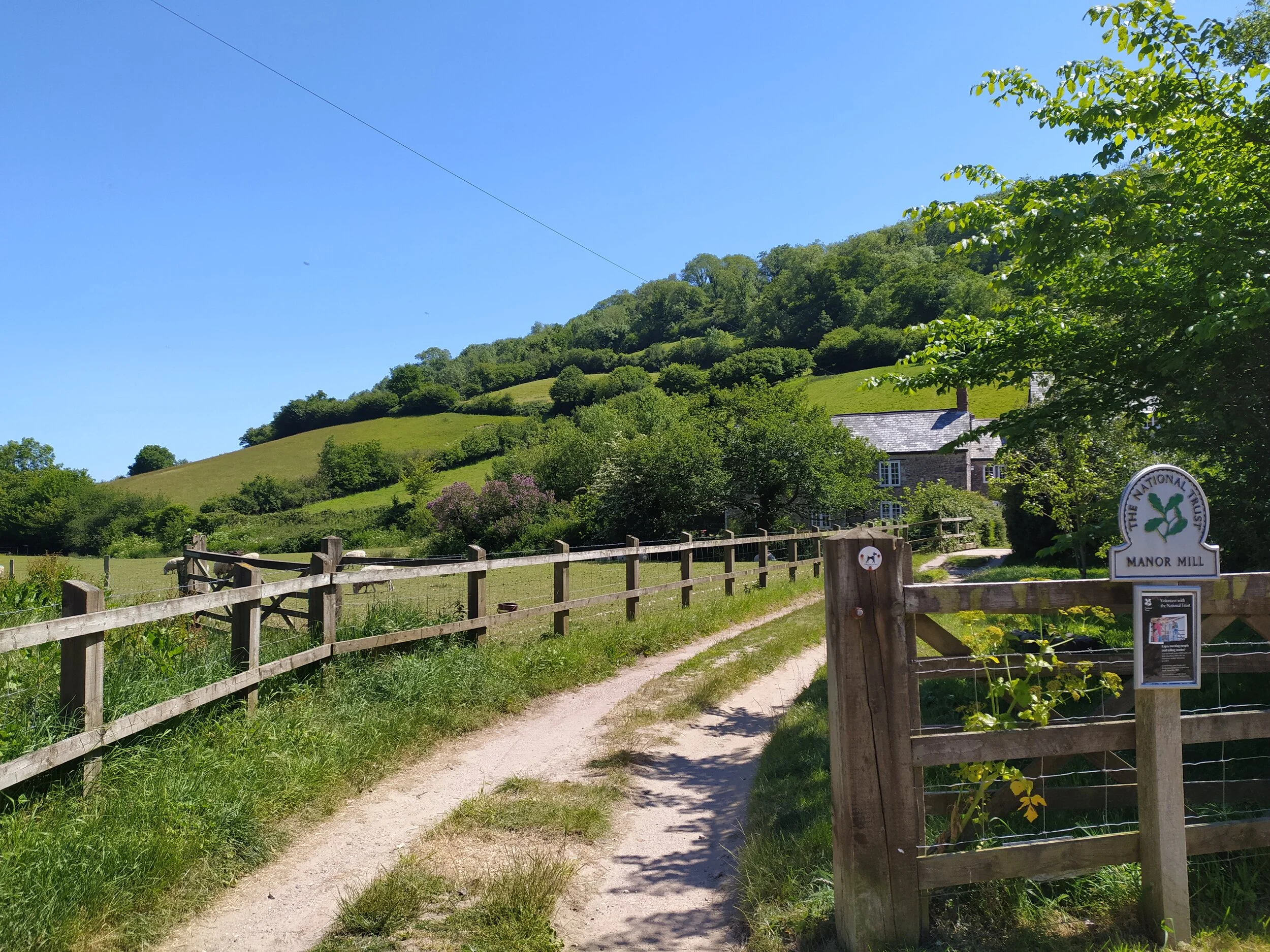
National Trust Manor Mill
After we left the trail through the gate, we continued to follow the stream straight ahead and onto a road where we were greeted with the thatched roof of the National Trust Forge. Despite Branscombe being well known for its many quaint little cottages, the Forge definitely stands out amongst the others. Reading a little about the Forge on a notice board, it is known to be the oldest working forge in Devon, and was built around 1580.

Branscombe Forge, blacksmiths here make decorative ironworks to sell.
As we turned left towards the hill, we admired some of the ironwork the blacksmiths had made at the Forge and had on display outside. You can just about make out in the picture above, the gate on display to the left, which had decorative bluebells on it.

Forge Cottage, available to let through the National Trust.
As we continued up the hill, on the opposite side to the Forge is Forge Cottage, a big yellow thatched cottage which I believe is a holiday let. It definitely stood out amongst all the other houses. As we walked up the hill I took one last look down the road, and couldn’t resist one last photo of the cottage and forge together before carrying on with our walk.

With the sun bearing down on us, we decided to take a break once we had made it to the top of the hill, but first we admired some more beautiful cottages along the roadside, they’re all decorated with beautiful flowers which really brings out the character of Branscombe.

One of the beautiful cottages in Branscombe.
Once we walked past these cottages, we found a bench by the village church, St Winifred’s. We sat here for a drink and took in the views down into the valley and admired some more cottages as we walked further along the road. As well as the cottages, a garden just up from the church really stands out as you walk past, its called ‘Doreen’s Garden’, I assume because its owned by a lady called Doreen! She lets people walk around this garden for free, but does ask for any donations to Devon Air Ambulance. .

Doreen’s Cottage, opposite her garden.

Just a small section of Doreen’s impressive and intriguing garden.
Once we walked past all these pretty cottages, we then approached a public footpath on the left. We didn’t follow this route, instead we carried on towards yet more cute cottages, and towards the Fountain Head Pub. Normally, it would be a perfect place to take a break and grab a bite to eat, but today it is of course, like every other pub, closed due to the pandemic currently happening, so we sadly had to walk past and remember it will soon be back to business and open again to enjoy.
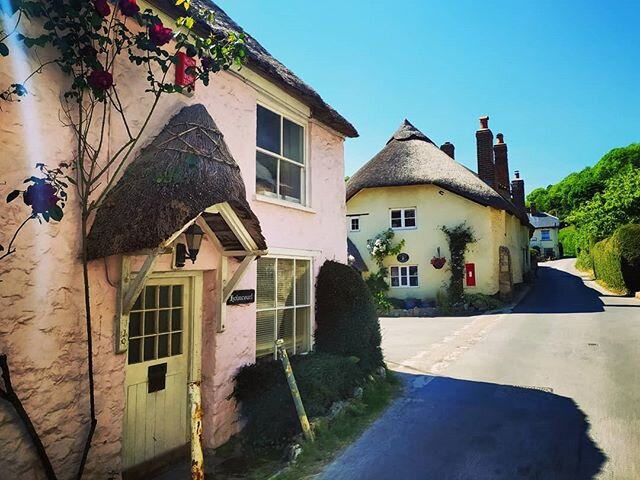
Some more beautiful cottages Branscombe has to offer, and the Fountain Head in the background.

The Fountain Head.
We turned left at the pub, and once we had rejoined another road, we needed to find a footpath sign heading towards the coast. We first walked up the hill, as we couldn’t easily see the sign, but once we were up the hill, and failed to see it, we walked down again and realised it was in fact slightly down the road, hidden by a hedge. If you decide to do this walk, don’t make the same mistake as us!

The footpath we struggled to find.
This footpath takes you up towards a trail shaded by trees and surrounded by wild garlic, which welcomes you with a National Trust sign informing you it is called ‘Pit Coppice’. We followed this path for a while until it then leads you through another gate and into an open meadow. We followed this path all the way along until we reached a signpost pointing us to the left, back towards Branscombe.

The trail through Pit Coppice.
Once turning left towards the coast path, you’ll follow another trail for a short while, it will boast beautiful views of Branscombe village to the left when it opens out into a field occupied by cows. Carry on walking the trail and eventually you’ll spot a lookout point to your right, which teases you with views of the blue sea and Branscombe pebble beach below.

The view of the sea and Branscombe beach from the coast path.
We carried on this coast path until it opens out to beautiful views of Branscombe beach and the cliffs beyond. You can also see the green hills that are part of the coast path leading to Beer. We’ve done that walk before, and although quite strenuous it is worth doing for the views and feeling of accomplishment. Here there is a bench you can sit and take in the views before heading down towards the beach.

Beautiful views of Branscombe beach and the coast path to Beer.
The walk was now quite easy going as we walked down some steps and through a gate into a field of grazing cows with their calves. From here we followed the path along side a beautiful house on the hill, and soon spotted the familiar beach huts and the pebble beach ahead of us.

Beautiful houses on a hill overlooking the beach.

From here we had one last look at the beach, I love the iconic fishing boat that’s always here, representing Branscombe beach well. As we walked back to the car we were reminded of the shipwreck that happened on the beach in 2007 with the anchor of MSC Napoli that now sits at the entrance to the beach greeting everyone who walks by. For anyone who hasn’t visited Branscombe before, its definitely worth a visit, the drive into the village is via narrow country roads, but the character this East Devon village has to offer is a must see.
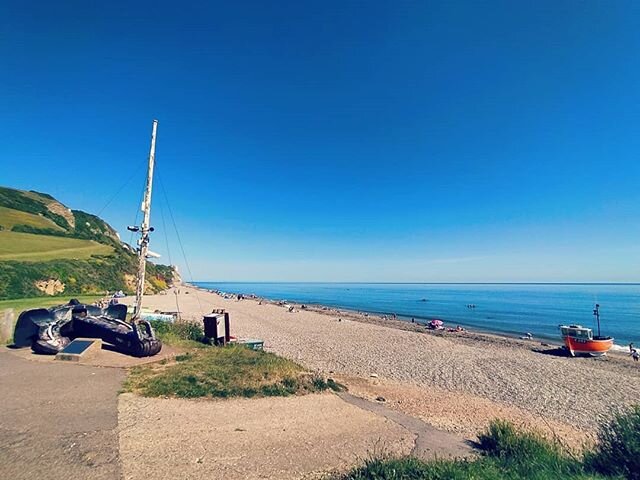
Branscombe beach with the iconic anchor and fishing boat.

Visiting National Trust Greenway
With the lovely weather we briefly had in March, we decided to make the most of it and visit a National Trust property nearby, located in the English Riviera of South Devon. After flicking through the NT book we have, we chose to visit Greenway House and Gardens, as it’s very dog friendly!

Located in Kingswear, South Devon, overlooking the River Dart, Greenway is the perfect location for a stroll around the gardens, taking in the views of the boats going past on the river, especially on a sunny spring day. It’s important to add, if you’re travelling by car, make sure you book a car parking space before you arrive as spaces are limited and must be pre booked. You can ring up on the day, the details are on the NT website.

Once we arrived, we were greeted by National Trust staff with a map of a suggested walk around the gardens and estate, that would help us see as much as possible of what Greenway had to offer. Before we set off on our walk, we decided to stop for a bite to eat at the courtyard cafe. Here there was plenty of seating, which was all outside, and plenty of choice on the menu. We ended up choosing the Savoury cream tea, tempted by the generous portions of locally made cheese, sweet chutney and cheese scones. I definitely recommend trying it!

The grounds are very dog friendly, including the cafe area and gift shops. Our dog, Amber was greeted by all staff, and treated to a doggy biscuit in the gift shop, she definitely wants to come back again! The only place that dogs aren’t allowed is in the Greenway house itself. I waited outside of the house with the dog, relaxing for a bit in one of the deck chairs on the lawn, overlooking the river, whilst Jo took a look around the house. Greenway house is best known for being the holiday home of famous writer Agatha Christie and her family. As Agatha was an avid collector, the house is filled with archeology and treasured finds from the family’s travels, and gives off a relaxing and homely atmosphere, reminding visitors why the family chose this as their summer holiday home.

Past the stable cafe and gift shop is a path leading to the walled gardens. Here there is quite a lot to explore, including the peach house, vinery and local school allotment plot. Walking around the walled gardens, taking in all the different plants that grow here, it’s clear to see that Agatha appreciated the outdoors, and made the most of the South facing sunny areas in the grounds. There was also a lawn behind the walled gardens, which we found out was called ‘Clock Golf’, named after the game Agatha and her family enjoyed playing while staying here.

We decided to walk through the vinery, appreciating all the different plants being grown here. I’m not very green fingered, but did recognise the hydrangeas and roses. Luckily for people like me, most plants and trees are labelled around the vinery and grounds, so you can identify them if need be. There is also a plant stall located outside the gift shop in the courtyard, that sells a lot of the plants you see grown in the wall gardens.

Once we left the walled gardens, we followed a path leading high up to the top garden. From here you can take in beautiful views of the River Dart, which is why Greenway is best visited on a clear, sunny day. As you follow the paths all the way down to the Boat house, you continue to get glimpses of the river, as well as Greenway house, along the way. There’s plenty of seating along these paths, reminding you to stop and take in your surroundings.

Before we continued on the path through the top garden, we took an alternate path, to walk around the fernery. With the golden light seeping through the trees here, and the relaxing atmosphere the water fountain creates, it feels like a secret garden hidden away from the main grounds. Agatha was a big dog lover, (hence why the grounds are so dog friendly) and in the fernery, there is a pet cemetery, where all of her beloved dogs are buried.

We continued on the path through the top gardens, taking in the views of the river, spotting Dartmouth in the background. As we walked further down towards the boat house, we spotted more water features and ponds, one being more ornamental with a statue of the ‘Goddess of mercy and compassion’ in the centre of it. Another pond called ‘The bird pond’ hosts a sculpture known as the ‘Greenway bird’, created by artist, Bridget McCrum.

After you descend from the top garden, you arrive at the edge of the estate, by the River Dart, where you can enter the Boathouse. This was one of my favourite places on the estate. On the sunny, blue skied day we visited, it was really relaxing to sit by the edge of the water, watching the boats sail past whilst soaking up the sun. Agatha Christie gained a lot of inspiration from her holiday home at Greenway, including the boathouse, which was included in the Poirot mystery ‘Dead Man’s Folly’, as the scene of the crime!

After we left the Boathouse, we climbed some steps and entered the Battery. Built in 1970 as a sea defence, the cannons still remain here, on the otherwise peaceful terrace. The Battery was another location of Greenway to inspire Agatha to write one of her books. In ‘Five Little Pigs’ the battery is the location where a famous artist is poisoned whilst painting his last portrait. Just sitting here and taking in the peaceful surroundings, you can see why Agatha found Greenway to be an inspiring place to write.

After you leave the Battery, you enter the famous Camellia Gardens, which, in the spring, is clear to see why Greenway is accredited by the ‘International Camellia Society’. The collections of Camellia in the gardens, includes many different varieties, that have been added to over the years, since around the 1830s, by each new owner that lived in the house. Due to the many varieties of Camellia that grow on the estate, Greenway hosted a Camellia festival this year to celebrate the success of being a ‘Camellia Garden of Excellence’, which I noticed was happening a few days after we visited in March. Even though I don’t know a lot about Camellia’s, I could appreciate how beautiful the different varieties were here, tucked away in a walled area of the grounds.

After leaving the Camellia Gardens through the walled archway, we walked up a path back towards the stable block cafe and courtyard. From here we had lovely views of the River on our left, and the Greenway House on our right. The gift shop is worth a look round, with some reasonably priced items, as well as a plant stall and second hand book shop located next door. We spent most of the day exploring the grounds, but we would definitely visit again, especially in the summer, as so far, this is my favourite NT estate we have visited, mainly due to the amazing views of the river and the peaceful location.